By Scrap Cove · Published 2 November 2026
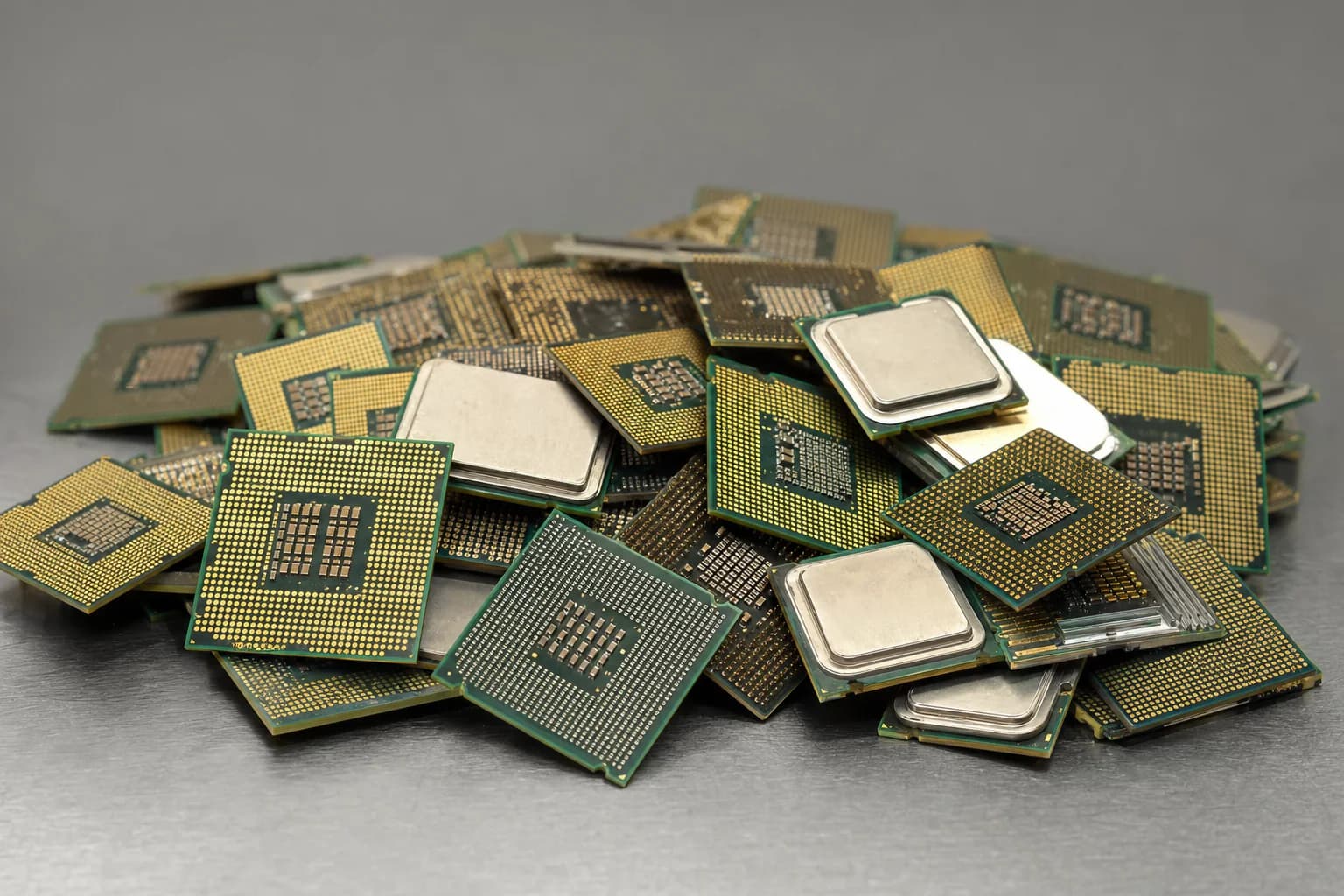
Weighing ceramic vs fiber CPU scrap is one of the first decisions a refiner, recycler or trader faces when sourcing processor material in bulk. The two grades come from different generations and constructions of processor, and they behave differently during sorting, preparation and downstream recovery. This guide compares ceramic, fiber, gold-plated pins and mixed CPU scrap side by side, explains how each grade fits common refining routes, and sets out what to ask for before you commit to a lot. It is written for registered businesses that buy by the pallet or container. It does not state prices or metal content, because both vary by lot and by buyer, and it is not a substitute for checking your own national rules.
In this article
- Key takeaways
- The four CPU scrap grades explained
- Ceramic vs fiber CPU scrap: a side-by-side comparison
- How the grade affects your refining process
- Choosing a grade by business model
- What to request before you commit to a lot
- How a bulk quote and export process works
- Compliance checks that apply to every grade
- Common mistakes when comparing grades
- Conclusion
Key takeaways
- Ceramic and fiber CPU scrap differ mainly in package construction, which changes how the material is handled and prepared before recovery.
- Metal content varies by lot within every grade, so no grade name should be treated as a guarantee of yield. Request a lot report.
- The best grade depends on your process, your preparation capacity and your appetite for variability, not on a single ranking.
- Technical data sheets, packaging details and a lot report give you far more to compare than a grade label alone.
- Every shipment depends on the destination and on your own licences. Check national electronic waste and export rules before ordering.
The four CPU scrap grades explained
Scrap Cove supplies bulk CPU scrap in four grades: ceramic, gold-plated pins, fiber and mixed. The grade describes the physical form of the material and how it has been sorted. It does not describe a fixed composition. Understanding what each term means in practice is the foundation for any comparison.
Ceramic CPU scrap
Ceramic CPU scrap consists of processors built on a ceramic package. These are typically older, rigid, often heavier units with a hard, brittle body and visible pins or contact surfaces. Because the package is a hard ceramic, the material tends to be dense and relatively uniform in form, although the internal construction and plating differ between processor families and manufacturing eras.
Fiber CPU scrap
Fiber CPU scrap consists of processors built on a fibreglass-reinforced or similar laminate substrate rather than a ceramic body. These units are usually lighter, may carry plastic or metal covers, and often come from different processor families than ceramic units. The fibre-based substrate means the material behaves more like a circuit board in preparation than like a ceramic part.
Gold-plated CPU pins and mixed CPU scrap
Gold-plated CPU pins are pins separated from processor packages, sold as their own grade for buyers who prefer to work with the pins alone. Mixed CPU scrap combines processor types within one lot, which can suit buyers who handle variety and do their own sorting. Both grades are covered by the same rule as the others: composition varies by lot, and a lot report is the right way to understand what a specific consignment contains.
Ceramic vs fiber CPU scrap: a side-by-side comparison
The table below summarises qualitative differences. It deliberately avoids metal content figures and values, because these depend on the individual lot and are not something a grade name can promise.
| Factor | Ceramic CPU scrap | Fiber CPU scrap |
|---|---|---|
| Package construction | Hard, brittle ceramic body | Fibreglass or laminate substrate, often with covers |
| Typical weight and density | Generally heavier and denser per unit | Generally lighter per unit |
| Preparation behaviour | Mechanical size reduction of a hard body is usually involved | Closer to board-type preparation, with organic material to manage |
| Visual sorting | Often easier to identify by eye | More variety in shape, covers and markings |
| Lot variability | Varies by processor families in the lot | Varies by processor families in the lot |
| Documents to request | Lot report, technical data sheet, packaging details | Lot report, technical data sheet, packaging details |
Construction and appearance
The most visible difference is the body. A ceramic unit is rigid and often has a uniform, smooth surface, while a fiber unit shows laminate layers, solder mask colouring or attached covers. This affects how quickly an inspector can confirm that a delivered lot matches the grade ordered.
Handling and preparation
Hard ceramic bodies and laminate substrates stress equipment differently. Ceramic bodies call for robust crushing or size reduction, and dust control matters. Laminate-based units introduce organic material and brominated or other additives in some cases, which affects thermal or chemical handling choices. Your own process engineers are best placed to judge which suits your plant.
Lot variability
Both grades vary. Two ceramic lots can differ in processor families, plating practices and condition, and the same is true of fiber lots. Treating either grade as a constant is the most common comparison error, and it is the reason a lot report matters more than the grade name.
How the grade affects your refining process
Refining routes differ widely between facilities and countries, so this section describes general considerations rather than prescribing a method. Your technical team should validate any choice against your own equipment, permits and environmental controls.
Feedstock consistency
Processes run most predictably when feed is consistent. A single-grade lot, such as ceramic only, gives a narrower range of physical form to design around. Mixed lots widen that range, which can be acceptable if your preparation stage is built to cope with it, but can complicate planning if your line is tuned to one form.
Preparation steps before recovery
Ceramic material generally needs size reduction suitable for hard, brittle bodies. Fiber material often needs separation of covers, laminate and metal parts before recovery, and may involve managing organic content. Pins, being already separated, remove much of that preparation but represent a narrower slice of the original processor, which may or may not suit your business model.
Residues and downstream handling
Whatever you choose, plan for residues. Ceramic processing produces hard mineral residues; laminate-based processing produces organic and glass-fibre residues. Disposal, classification and treatment of these residues are governed by local waste and environmental rules, which differ between countries and regions. Confirm these requirements before you scale up a new feedstock.
Choosing a grade by business model
A sensible choice starts with what your facility is set up to do, not with the grade that sounds most attractive. The three profiles below are common starting points.
Refiners with in-house preparation
Refiners with strong mechanical preparation and laboratory capacity can often work with a wider range of forms. For them, understanding what shapes each bulk quote for ceramic CPU scrap helps compare options on a like-for-like basis, while mixed grades may fit if the plant can sort and sample reliably.
E-waste processors and recyclers
Processors who already dismantle electronics may prefer fiber CPU scrap because its handling resembles board processing they already perform. Others prefer ceramic because it is distinct and easy to segregate. The deciding factors are usually existing equipment, labour for sorting and where residues will go.
Traders and importers
Traders need to be confident that the grade described to a downstream buyer matches the goods shipped. For this audience, clear grade definitions, packaging information and a lot report are essential, as is a clear view of which destinations and licences apply to each onward sale.
What to request before you commit to a lot
Because composition and condition vary, the quality of your buying decision depends on the information you collect. Ask for the following, and keep a written record of each answer.
- A lot report describing the specific consignment you are considering, since metal content varies by lot.
- The technical data sheet (PDF) for the grade, so your technical team can review the description in writing.
- Packaging details, including how the material is contained and how it is presented for handling.
- Information on quantity, in pallets or containers, and any minimum order that applies to your request.
- Confirmation of the destination and of the licences you hold, so the destination review can proceed properly.
The lot report
A lot report is the practical answer to the question "what is actually in this lot?" Compare it against your own assay or acceptance criteria. Do not rely on a grade name, an average or a past lot as a prediction for the next one.
Technical data sheets and packaging details
Technical data sheets are provided per grade in PDF form. Use them to align internal teams, from purchasing to plant operations, on what the grade is and how it is described. Packaging information supports your receiving procedures, storage planning and any onward handling.
How a bulk quote and export process works
Scrap Cove sells to registered businesses by request for quote. There are no list prices, because each quote is prepared individually after a buyer and destination review. This reflects how the trade works: the grade, quantity, destination and buyer circumstances all matter.
Request a quote and destination review
The process begins with your request. You state the grade or grades of interest, the approximate quantity and the destination country. The review considers the buyer and the destination. Scrap Cove does not ship to restricted destinations, and a shipment is only considered in light of the destination and the buyer's own licences. Nothing in a quote request should be read as confirmation that an export is permitted.
What shapes a quote
Grade, quantity, lot characteristics, packaging and destination are among the factors that can influence a quote. The resource on ceramic CPU scrap price factors explains these in more detail. Preparing your requirements in advance helps keep the conversation focused and comparable between suppliers.
Compliance checks that apply to every grade
Compliance is not a final step. It should shape the choice of grade from the start, because rules can treat materials differently depending on classification, condition and destination. This article does not provide legal, tax or customs advice.
Electronic waste rules
Many countries regulate electronic waste, including how it is classified, stored, transported, processed and reported. Some distinguish between waste and material intended for recovery in a licensed facility. Check your own national and regional rules, and confirm that your facility holds the permits required for the grade and process you intend to use.
Export and import licensing
International frameworks such as the Basel Convention on hazardous wastes influence how many countries treat cross-border movements of electronic scrap, but each country applies its own rules, and some restrict or prohibit certain imports. As a buyer, you are responsible for confirming that you may import the material, and for holding the licences that apply. Speak to your competent authority or a qualified adviser if there is any doubt.
Common mistakes when comparing grades
Several errors recur in bulk CPU scrap purchasing. Avoiding them improves both the comparison and the outcome.
- Treating grade as composition. A grade describes form and sorting, not a fixed metal content. Always use a lot report.
- Comparing quotes without matching specifications. Quotes for different grades, quantities, packaging or destinations are not directly comparable.
- Ignoring preparation capacity. A grade that suits another plant may not suit yours if your equipment or labour is different.
- Leaving compliance until after the order. Licensing and waste classification can change what you may buy, so check early.
- Assuming past lots predict future lots. Lots vary, and each should be assessed on its own documentation.
- Overlooking residues. Plan the disposal route for each grade before it arrives.
Conclusion
Ceramic and fiber CPU scrap differ in construction, handling and preparation, while pins and mixed grades offer further ways to match feedstock to a process. No grade is better in every case: the right choice depends on your equipment, your compliance position and the information you hold about the specific lot. To compare grades for your own operation, review the technical data sheets and submit your requirements through the request-a-quote page on the Scrap Cove website.
Frequently asked questions
What is the main difference between ceramic and fiber CPU scrap?
The main difference is the package. Ceramic CPU scrap has a hard, brittle ceramic body, while fiber CPU scrap uses a fibreglass-reinforced or laminate substrate. This changes how the material is handled and prepared before recovery.
Which grade contains more precious metal?
It is not possible to say from the grade name alone. Metal content varies by lot within every grade, so buyers should request a lot report and compare it against their own acceptance criteria.
What grades of CPU scrap does Scrap Cove supply?
Scrap Cove supplies four grades in bulk: ceramic, gold-plated pins, fiber and mixed. Technical data sheets in PDF form are available per grade.
Are there list prices for bulk CPU scrap?
No. Each quote is prepared individually after a buyer and destination review, so you need to request a quote with your grade, quantity and destination.
Is mixed CPU scrap a good choice for refiners?
It can suit buyers whose plants can sort and handle varied material. Buyers with a line tuned to a single form may prefer a single-grade lot. Review the lot report before deciding.
Can any business import CPU scrap?
No. Rules on electronic waste and imports differ between countries, and some destinations are restricted. Buyers must check their own national rules and hold any licences required, and Scrap Cove does not ship to restricted destinations.
Who can buy from Scrap Cove?
Scrap Cove sells to registered businesses such as refiners, recyclers, e-waste processors, metal traders and importers, buying by the pallet or container by request for quote.
What should I ask for before choosing a grade?
Ask for a lot report, the technical data sheet for the grade, packaging details, and confirmation of how the destination and licence review works. Keep these records for your compliance file.